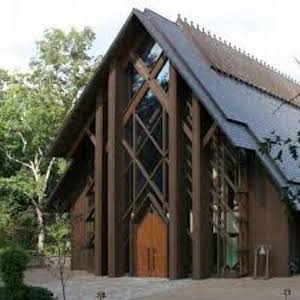
If you're interested in exploring the cultures of the past, Medieval and Early Modern Studies may be for you. On a historical journey from the fall of Rome through the eighteenth century, you will encounter vast wealth alongside extreme poverty, deep piety alongside brutal religious conflict, and intense creativity alongside the ravages of plague and warfare. You will engage with texts, architecture, and art that may seem distant from modern life but which continue to inform—for good and ill—the ways we engage with important issues ranging from religion to gender and power.

Why Medieval & early modern Studies at Sewanee?

The Medieval and Early Modern Studies program at Sewanee is designed to develop a cross-disciplinary overview of these historical periods, incorporating the study of the arts, literature, history, and philosophy, as well as to offer scope for mentored research projects in pursuit of the student's own distinctive scholarly interests.

We encourage our majors and minors to take advantage of a range of study-away opportunities, including a longstanding relationship with the Centre for Medieval and Renaissance Studies at Oxford. Founded in 1975, the institute provides academic training for overseas students who wish to complete part of their education at Oxford in these areas of study.

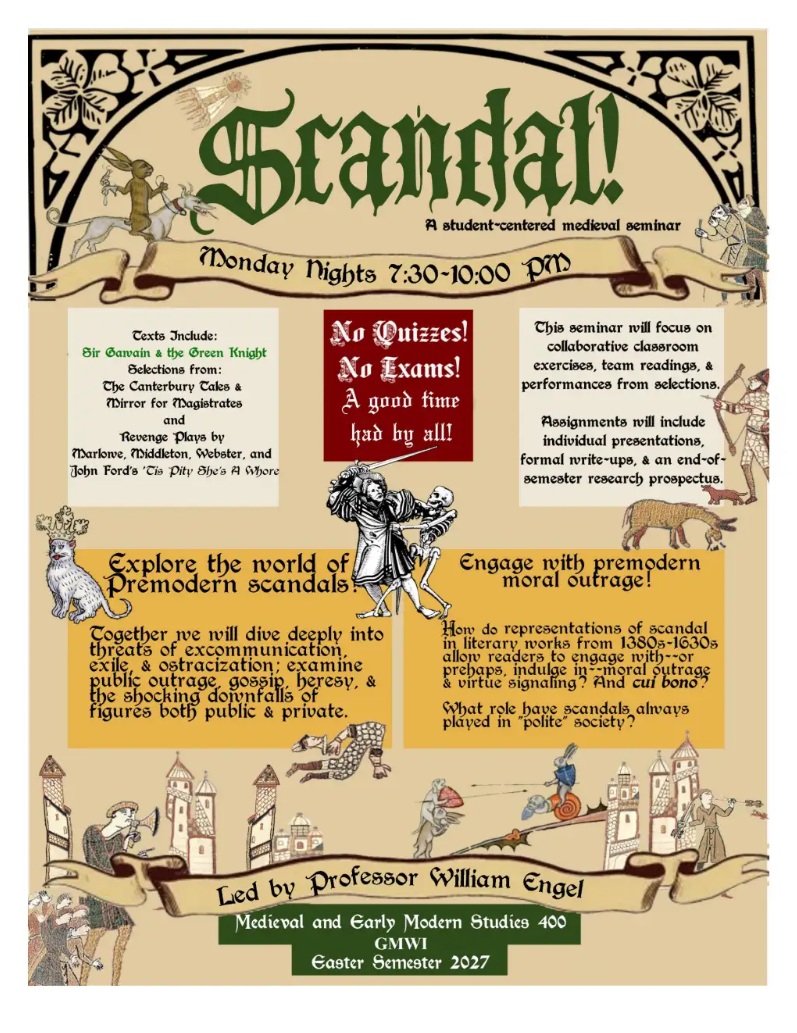
Sewanee also offers an opportunity unique among small liberal arts colleges as host of the Sewanee Medieval Colloquium, an annual academic conference. The colloquium is held each spring and draws scholars from across the country (and beyond) to campus; student attendance at all the events is welcomed, and participation by majors and minors is encouraged.
Research Spotlight: Betsy Baker C'27

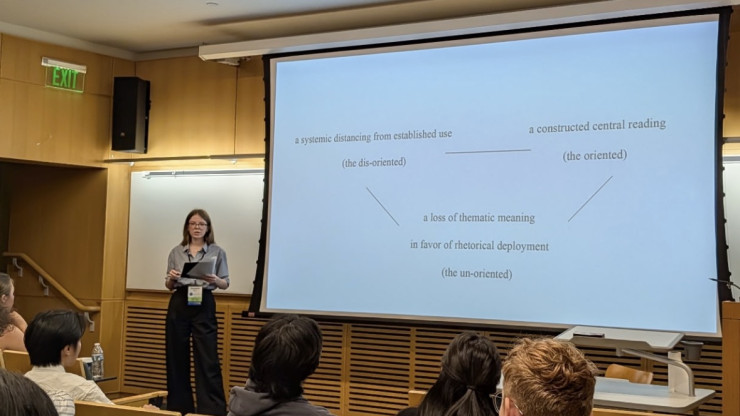
In March 2026, Medieval & Early Modern Studies minor Betsy Baker presented an essay entitled "Re-Reading Medieval Reading: Approaching Psalm 132 as a Case Study for (Dis/Un)Orientation in the Psalmic Tradition" at the Richard Macksey National Undergraduate Humanities Research Symposium, hosted by Johns Hopkins University. Drawing on the presence of Psalm 132 in St. Augustine's Enarrationes, the Glossa Ordinaria, and the recitation of the Psalms in the Divine Office, she argued for a new paradigm of categorization and interpretation to better understand the use and significance of reading in monastic spaces according to social need. Reflecting on Jacques Derrida's spiraling theory of discursive boundaries and referential definition, she sketched an axis of thematic and interpretive orientations (dis-orientation, un-orientation, and orientation) to systematically break down, define, and contextualize medieval reading. Betsy's work emerged from MEMS 400: Early Soundscapes in Literature, Art, and Music, taught in Easter 2025 by Prof. Stephanie Batkie. MEMS 400 is offered in the college every second spring, running in conjunction with the Sewanee Medieval Colloquium.

A Sampling of Courses

Medieval & Early Modern Studies

Programs of Study

Requirements for the Major & Minor in Medieval & Early Modern Studies

Meet some professors

Contact

James Ross Macdonald
Professor of English

jrmacdon@sewanee.edu

Gailor Hall 129, ext. 1338