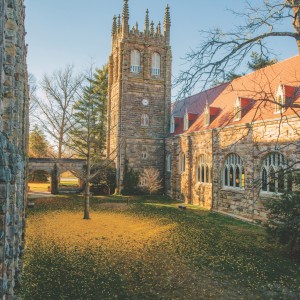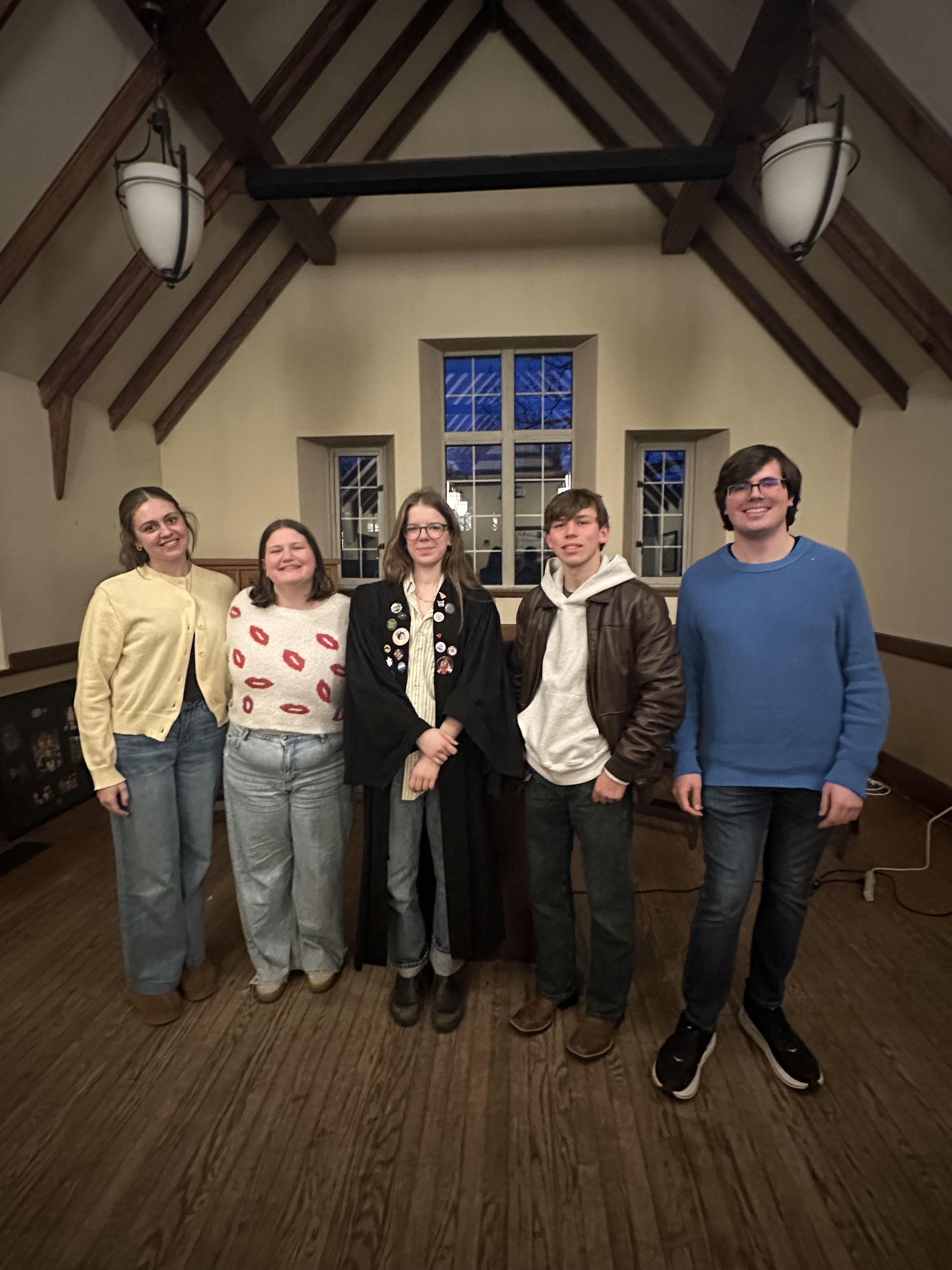
Faculty and students gathered in McGriff Alumni House on February 25, 2026 to hear a spirited debate that examined a topic important to our campus community: the University parking policy. Sponsored by Sewanee Debate Union (SDU) and the Student Government Association (SGA), this event provided an opportunity for not only hearing different arguments about the policy through debate, but also for audience members to respond, raise questions, and discuss solutions.
Mary Webster Burke (C’26 in Rhetoric and Women’s and Gender Studies) and Maeve Fitzgerald (C’29 in Rhetoric) led the Affirmative in favor of a change to the current parking policy. Fitzgerald’s opening statement highlighted challenges faced by some students who struggle to navigate a policy that requires them to park their vehicles at a considerable distance from their dormitories. She called for a reevaluation of how parking zones are assigned and greater clarity around how the current policy is implemented. As a student athlete, she underscored how “safety and student welfare are at the center of Sewanee’s mission.”
Jack Collins (C’29 Undeclared) and Aidan Jones (C’26 in Philosophy and Rhetoric) led the Negative, favoring a retention of the current parking policy. Collins countered the Affirmative’s position by raising the importance of managing traffic flow on campus, suggesting that there are adequate parking spots available to students, and underscoring that Sewanee benefits from maintaining and promoting our status as a “walking campus.” The Negative’s view, then, was that the policy itself only works if people follow it.
Following Affirmative and Negative opening statements, SDU President Betsy Baker (C’27 in Classics) facilitated audience discussion before hearing rebuttals. Attendees raised questions about how the University shuttle service impacts parking on campus, how to promote safety for students walking at night, how parking zones affect parking spaces for faculty and staff, how best to communicate changes to University policy, and where funds from parking tickets go.
Through rebuttal, Mary Webster Burke responded to the Negative by emphasizing two key points: 1) the vitality of the University Shuttle service and 2) concurred with the importance of students following the current policy if zones do continue. She likewise cited frustrations held by students who do follow the policy, but still cannot park in their assigned spot. Aidan Jones, for the Negative, responded by stating that zone parking works well in theory, and that any changes or refinement might happen in implementation. He called for a reasonable revision to the current policy that guarantees students are assigned parking spots at or near their dormitory, that overflow parking be adjusted, and that the University shuttle operate more consistently (especially on weekends). He suggested that students might be surveyed to gain a clearer sense of the full picture and possible solutions to persisting concerns.
During a second round of audience discussion, SGA Vice President Jack Slade (C’26 in Rhetoric) highlighted Sewanee’s uniqueness as a walkable campus. The audience unpacked this view with some further discussion about how the process by which students are assigned to parking lots currently unfolds by rank and seniority, but might better take into account how walk ability impacts and is impacted by specific student groups such as athletes, Bonnor/Canale students with positions at off-campus sites, and students with documented disabilities. Discussion also considered how other institutions limit or restrict first-year students from even having a vehicle on campus, with some audience consensus arising about how this would likely be unfeasible given Sewanee’s remote location, concerns about travel, and access to off-campus services or facilities such as CVS for prescriptions. Students also raised concerns about the economic pressures placed on those who have to frequently pay tickets. Might community service be a more appropriate penalty for a parking ticket, one attendee wondered?
In sum, this event showcased the importance of creating spaces and forums for students and faculty to come together, engage campus and local controversies, and do so through structured and collegial debate that allows audiences a voice too.
Lily Mobley (C’26 in American Studies), President of the Order of the Gown, stated that she is “grateful for the opportunity to have debate about a pressing campus issue.” “This was certainly informative, and I hope that every student takes this as encouragement to continue these conversations elsewhere and with administrators and other decision makers on campus,” she reflected.