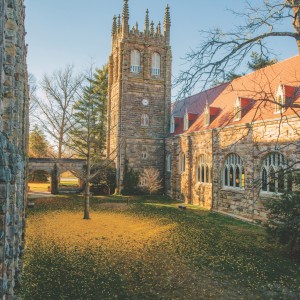
In Advent 2025, Dr. Melody Lehn’s RHET 331: Voices of American Women class partnered with the Monteagle Sunday School Assembly (MSSA) for a semester-long archival research project. The work was made possible by earlier student research undertaken by Sewanee alums Sophia Burr and Silas McClung under a McCrickard College Faculty Development Grant and a 2025-26 Civic Engagement Faculty Fellowship. Students spent the semester researching the historical, political, and rhetorical contributions of women across professions whose names appeared in late 19th and early 20th century summer programs. As part of their work, students penned short essays about their subject for the Assembly’s summer newsletter, featured below.
The June 14 newsletter launched a six-week series on “MSSA women orators.” An editorial statement by MSSA’s archivist Morgan Merrill (Sewanee C’73) opened the series: “In the fall of 2025 Dr. Melody Lehn, a professor at Sewanee, contacted me to discuss a project for her rhetoric class. She asked if the students could have access to the Archives to research women who had lectured at MSSA beginning in 1882 and write essays about what they had discovered. In return, the students scanned the original programs for the Archives! The essays will be printed in Mountain Voices during the summer season.”
“Zeal, Ardor, and Earnestness: Dr. Carolyn Geisel and the Monteagle Sunday School Assembly” by Erin Graffeo, Helen Newcomb, and Jack Slade opened the series. The student authors researched Geisel, a Michigan native and medical doctor who was a favorite on the annual Chautauqua lecture circuit. Geisel’s lectures tackled societal health problems and preventative medicine, along with how “health” in the home was a “woman’s business.” She blended arguments for traditional womanhood with calls for more progressive approaches to health care, including in talks at the MSSA
On June 21, the MSSA newsletter focused attention on Clara Gregory Baer, who Ariel Hornek and Elle Shepherd studied. Their article “Clara Gregory Baer’s Accomplishments and Time at The Monteagle Sunday School Assembly” highlighted how Baer’s contributions as a physical education teacher and advocate for increased and improved women’s participation in athletics shaped her rhetorical career as a lecturer. Baer famously innovated the rules for women’s basketball. They find that Baer helped to make the MSSA and Monteagle more broadly a “a place where Southern teachers—especially women—could acquire new credentials, methods, and ‘physical culture’ practices, and then carry them back into communities across the country.”
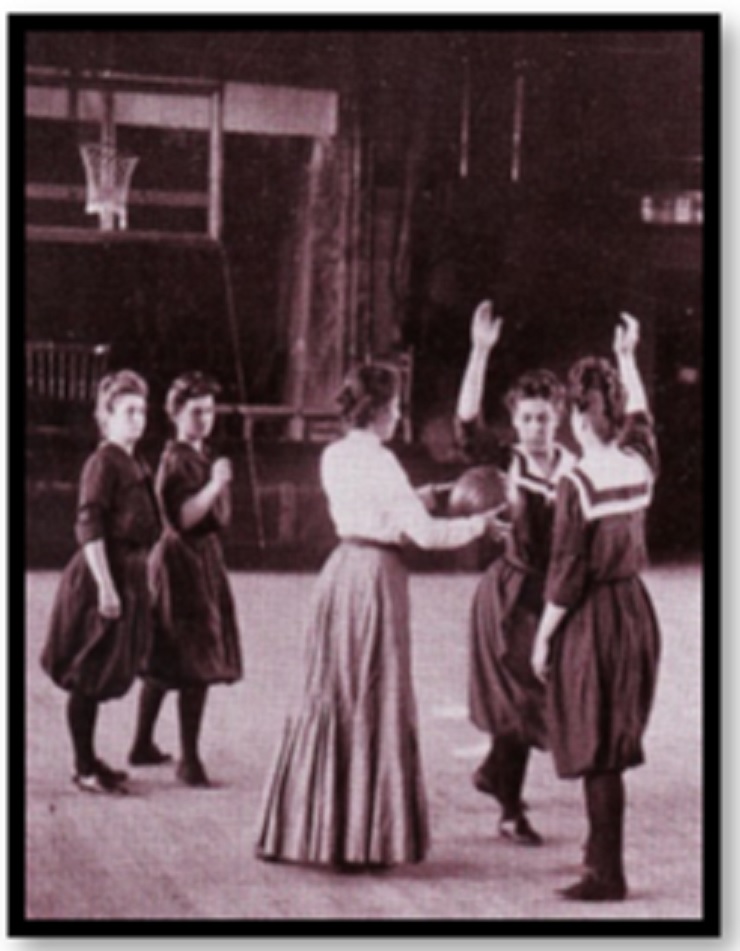 Source: “The Dawn of Women’s Basketball” (2017)
The June 28 newsletter included an article about the Assembly’s much-beloved resident Lucy Somerville Howorth. With their article “No, Not Judge Judy, We’re Talkin’ ‘Bout Judge Lucy: A Rhetorical Analysis of Lucy Somerville Howorth,” Annabel Eppes, Evey Knopf, and Erin McLaughlin approached Howorth, who has been the subject of a full-length academic biography, through the lens of how her relationship with the MSSA shaped her voice as a suffragist, lawyer, New Deal judge, and advocate of appointing more women to government positions. Howorth’s rhetorical contributions to the MSSA, they found, are located in her leadership as first female president of the Assembly and her informed consulting on finances.
Amelia Claybrook, Kate Lowe, and Victoria Quintero contributed “Women in ‘Their Place’ But Making it Their Own: How Emma P. Ewing Revolutionized the Kitchen at the Monteagle Sunday School Assembly” to the July 5 newsletter. A popular culinary educator and lecturer, Ewing self-taught herself how to navigate the kitchen and channeled what she learned into public speaking and writing. Her cookbooks graced the bookshelves of the nation’s top culinary institutes, and she made her name as a cooking instructor within the Chautauqua Movement. She visited the MSSA in 1886, just two years after its founding, and lectured on “Our Kitchen Interests.”
“Dr. Mary Harris Armor: The ‘Southern Joan of Arc and Exvangel of Temperance’” by Nate Moss, Stella Seydel, and Kristina Wilkerson appeared in the July 12 newsletter. Georgia native Armor had a longstanding relationship with the MSSA, and made repeated appearances within her broader experience as an in-demand Chautauqua circuit lecturer who advocated for temperance. At one point, she was regarded as “the world’s greatest woman orator.” She appeared at the MSSA in 1907 as part of a broader “Woman’s Congress Week” and dazzled her listeners with her unapologetic arguments for “total abstinence.”
The July 19 newsletter featured an article by Sarah Grace McDowell, Elizabeth Slade, and Ayre West entitled “Silena Holman: The Clever Woman Who Captured Monteagle.” Holman was a longtime member of the Women’s Christian Temperance Union who contributed to Tennessee’s temperance campaigns. She was a frequent lecturer at the MSSA who, according to local news coverage, reliably delivered speeches that “exceeded all expectations.”
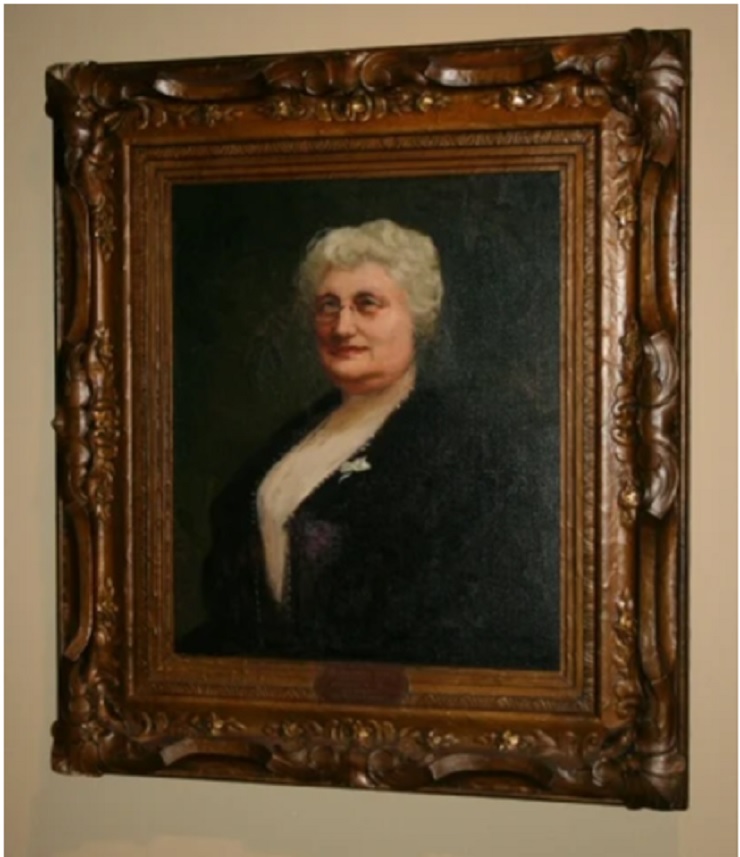
Source: Aubrie McDaniel, “From Prohibition to Suffrage, the Woman’s Christian Temperance Union Played a Role”
Dr. Lehn also gave two talks at the Assembly this summer as part of their summer lecture series. She visited on June 30 to talk about the RHET 331 class’s project and to engage in a dialogue with Assembly members, some of whom fondly recalled longtime MSSA member Lucy Somerville Howorth. On July 29, she presented “On the Basis of Sex: First Ladies and Suffrage,” drawing from her recent chapter in The Cambridge Companion to US First Ladies (Cambridge University Press, 2025).