Imagining CEL: Projects and Ideas Within and Beyond the Gates
Can STEM courses thrive within the CEL model? Faculty share how community partnerships, real-world research, and student leadership are transforming STEM teaching and learning.
The Office of Civic Engagement supports faculty across disciplines as they integrate community engagement and service into coursework in order to promote student inquiry about specific places and issues, deepen students’ understanding of diverse perspectives, and encourage students’ development as civic agents.
The Office has an extensive list of community partners. Faculty who are interested in integrating community engagement into their teaching or research should reach out to the OCE Director, Amy Patterson to discuss their pedagogical objectives so that the office can help faculty find an appropriate community partner.
Imagining CEL: Projects and Ideas Within and Beyond the Gates
Can STEM courses thrive within the CEL model? Faculty share how community partnerships, real-world research, and student leadership are transforming STEM teaching and learning.
Community Engaged Learning- Advent 2025
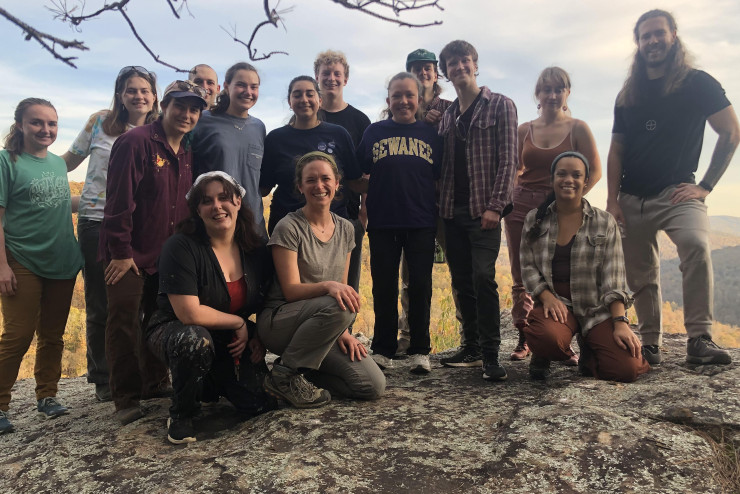
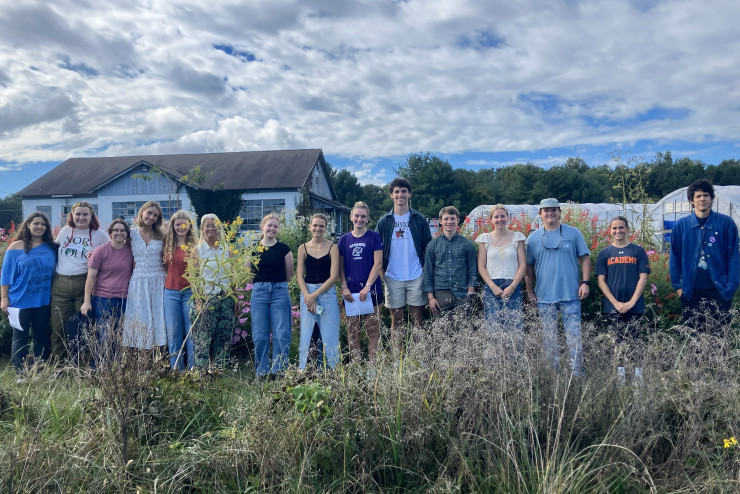
As the semester concludes, Sewanee celebrates a new cohort of CEL fellows whose courses strengthened community partnerships while enriching student learning. From environmental justice work with regional farms, to archival research amplifying women’s rhetorical history, to AI-supported communications projects for local nonprofits, these courses demonstrate the versatility and impact of community-engaged learning. Together, faculty and students advanced meaningful collaboration, career readiness, and Sewanee’s commitment to its surrounding communities.
The Certificate in Community Engagement for Collaborative Change (CCECC) brings together what students learn in the classroom with real-world applications to make sense of issues of concern to communities. Students work across academic disciplines to gain collaborative skills and reflect on their leadership on and off campus. The certificate welcomes students from across the arts, humanities, social sciences, and sciences.
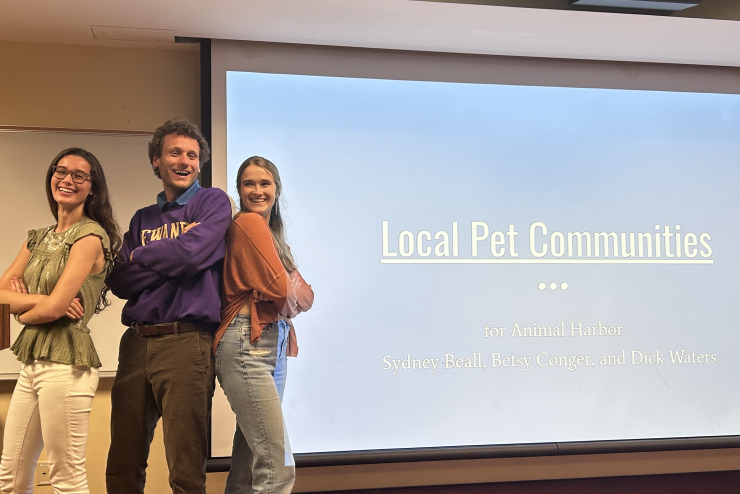
The Community-Engaged Learning program offers academic courses across the curriculum with a community engagement component. Each course integrates community engagement and service to activate the liberal arts. Students can search the schedule of classes on the registrar's website for courses with "Community Engagement" in the description.
Proposals for Civic Engagement course designation will be reviewed by the Office of Civic Engagement. If you have questions about these criteria for Civic Engagement courses or would like assistance in developing a civic engagement course, please contact Amy Patterson, aspatter@sewanee.edu. Please submit the form linked below, your syllabus (or course outline, if syllabus is not complete), and your proposal to ce@sewanee.edu.
Community Engaged Learning Faculty Fellows develop courses and research opportunities that enhance students’ learning through community engagement. Fellows participate in workshops and personalized advising to build connections with community partners and craft course offerings that link classroom learning with hands-on experiences that promote social good. Fellows mentor other faculty to offer future community engagement courses.
Here are some additional resources about community-engaged learning courses.

Over the course of the 2025 Spring semester, the Sewanee Theatre & Dance Department offered a Community Engaged Theatre Course taught by Assistant Professor of Theatre Sarah Lacy Hamilton sponsored by the Roberson Project.
The primary goal of the course was to engage with Sewanee’s historic Black community, better known as the St. Mark’s Community, and to hear their stories of growing up and living in Sewanee. The course culminated in a performance featuring original scenes, monologues, and songs that were written, directed, designed, and performed by the students. Their goal was to reflect the stories of the St. Mark’s Community and bring awareness to the community’s history and future.
An interdisciplinary examination of the theoretical and analytical tools essential for an understanding of civic engagement and leadership. Topics focus on typical problems faced in the context of community change, including, but not limited to, framing social issues; qualitative and quantitative field research methods; socioeconomic, cultural, political, and global structures underlying poverty; the social change model of leadership development; human capabilities perspective; and cross-cultural communication.
How can psychology be applied to strengthen communities and promote social change? This course explores how people influence, and are influenced by, the social environments they are part of. Examine the role of psychology in understanding and addressing social issues through collaborative, action-oriented approaches. Explore the psychological factors that shape community engagement, empowerment, and resilience. Learn about theories and methods that guide community-based research and intervention, with a focus on participatory approaches that prioritize the perspectives of those most affected by social injustices. This course prepares students to apply psychological principles to real-world challenges.
This course provides an introduction to nutrition and focuses on the relationship between diet and health. Topics include physiological requirements and functions of protein, energy, and the major vitamins and minerals that are determinants of health and diseases in human populations. These basic concepts are applied to societal issues, including the role of diet in malnutrition, heart disease, cancer, and diabetes. Community engagement.
Singing from the Sacred Harp hymnal represents an old but still rewarding Southern musical practice, suitable for all amateurs willing to sing loudly. In twice-a-week practices, we cover the fundamentals of shape-note singing and learn to sing in parts. Approximately once a month we travel to Alabama to participate in one of the traditional Sacred Harp singings.
Open only to students pursuing curricular certificates in civic and global leadership; Prerequisite: CIVC 100 or CIVC 200.
Integrating theory, methods, and analytical tools central to academic approaches to civic engagement and leadership with their concentration coursework, students in this seminar work with faculty and site supervisors to design and complete a semester-long research project to address a specific problem that emerged during the course of their practicum experiences. Restricted to students pursuing the certificate in civic and global leadership.