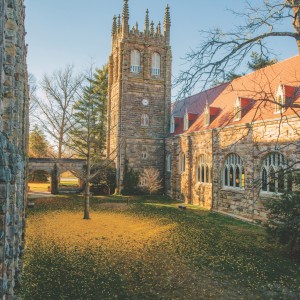
"Sewanee ended up being great and probably changed the trajectory of my life."
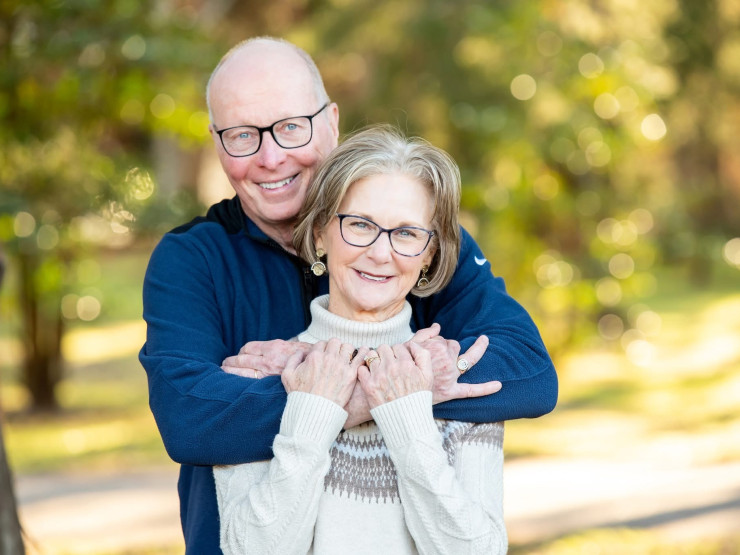
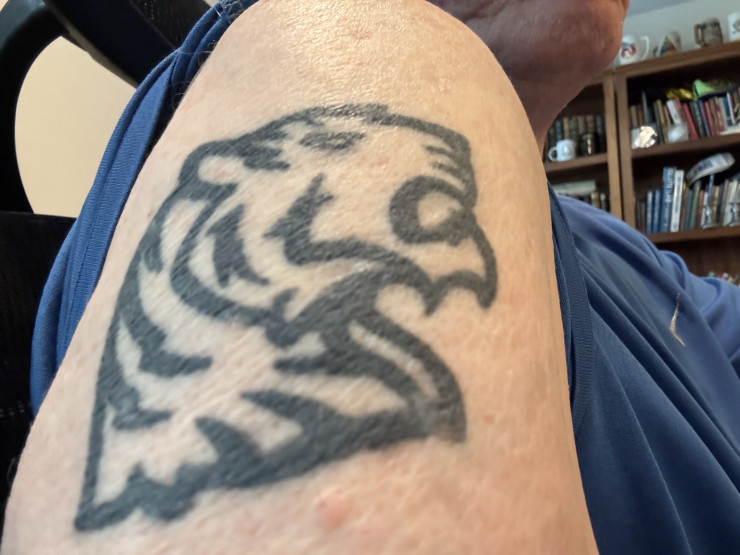
Ask Kevin Harper, C’75, how Sewanee left an impression on him, and the conversation could go two ways. He will gladly talk about the friendships he made through the University’s cross-country and track and field programs, or the communication skills he picked up as a philosophy major. But he might also describe a more tangible mark: the Sewanee Tiger tattoo he acquired in 2022.
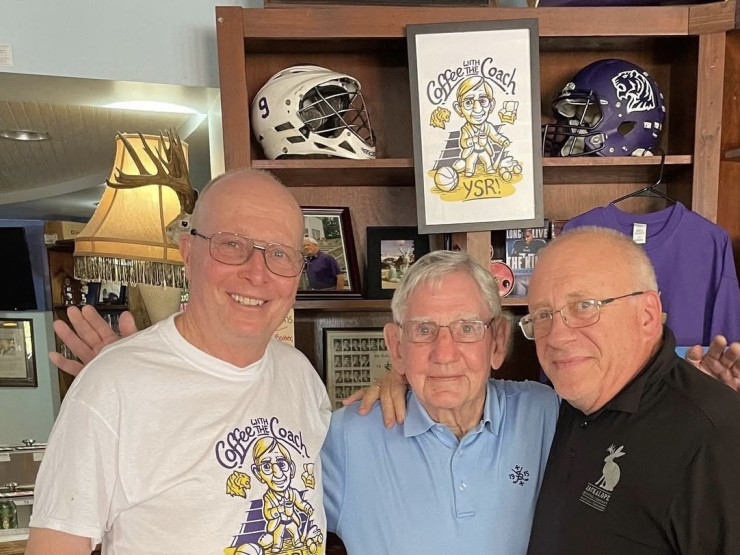
As these stories sometimes unfold, Harper says he decided to get inked on the spur of the moment and after a few beverages. He was traveling home to Virginia from Sewanee’s Hall of Fame Weekend, which he had attended in celebration of his friend Bambi Downs, C’80, and as a ride for Sewanee’s former athletics coach Dennis Meeks. After spending the night in Asheville, where Meeks lives, Harper went to Catholic Mass, then stopped at a barbecue joint. “I had a couple of beers,” he says, “and I thought: ‘You know what I need? I need a Sewanee Tiger tattoo.’”
In case it isn’t obvious, Harper is rather devoted to his alma mater. In addition to the tattoo, he boasts a license plate reading “SEWNEE,” plus a collection of framed memorabilia from his years on the Mountain. In honor of his 50th Sewanee reunion last year, he established a generous planned gift to the Class of 1975 Endowed Scholarship Fund.
Harper describes his University philanthropy as an act of love, inspired in part by two Catholic saints. “St. Thomas Aquinas defined love as willing the good of the other, simply because they’re ‘other’—and not getting anything in return,” he says. “And St. Maximilian Kolbe said, ‘Without sacrifice, there is no love.’” In combination, these two concepts of love create a powerful rationale for scholarship giving, Harper says.
Harper’s loyalty to the University might come as a surprise to his younger self. As a teenager at Maplewood High School in Nashville, he dreamed of attending a Division I college and pursuing a career as a professional runner. When Meeks visited Maplewood to recruit him, Harper listened politely but was far from sold. Then, Harper’s father got involved. “My dad said, ‘I’m not going to pay for you to go anywhere else.’”
Fortunately, by the end of his freshman year, Harper had warmed up to the campus considerably. “Sewanee ended up being great,” he says, “and probably changed the trajectory of my life.”
As Harper describes it, the enthusiasm that his father held for Sewanee was a product of both the University’s academic reputation and the tuition support coordinated by former Director of Financial Aid and Placement Elizabeth Chitty. “Mrs. Chitty, bless her heart, made it so that a Sewanee education cost as much as going to a state school,” Harper says. “I’ll be indebted to her forever.”
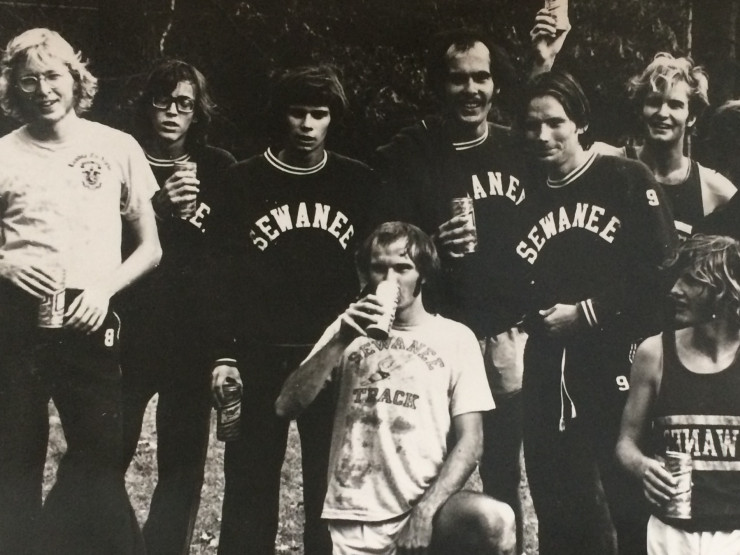
Though Harper deferred to his parents on his college choice, he did not pursue the pre-med path they envisioned for him—at least, not for long. “Freshman chemistry decided for me that I was not going to be a doctor.” Instead, he gravitated toward Sewanee’s Philosophy Department, and particularly to courses taught by the late Professor of Philosophy Hugh Caldwell. Aside from serving on the University’s faculty, Caldwell founded Sewanee’s Ski and Outing Club and occasionally participated in marathons. “Being a runner, I would give him pointers every once in a while,” Harper says.
As a student-athlete, Harper developed a close bond with Meeks, who coached him for two years in cross-country and four years in track and field. Athletics also introduced Harper to current Vice-Chancellor Rob Pearigen, C’76, P’14, P’17, who was then serving as a student trainer for the Sewanee men’s basketball team. Pearigen’s leadership potential was clear from the start, Harper says. “There was just something about him. I was like, ‘Man, that guy’s going to be something.’”
In 1973, during Harper’s junior year at Sewanee, he achieved a key ambition: He was named a national All-American in cross-country. In 2005, he was inducted into the Sewanee Athletics Hall of Fame. The timing of his undergraduate athletic accomplishment is significant, he says. “The first year of Division III sports was 1973, and cross-country was one of the first athletic events that held a Division III championship. Talk about the planets lining up.”
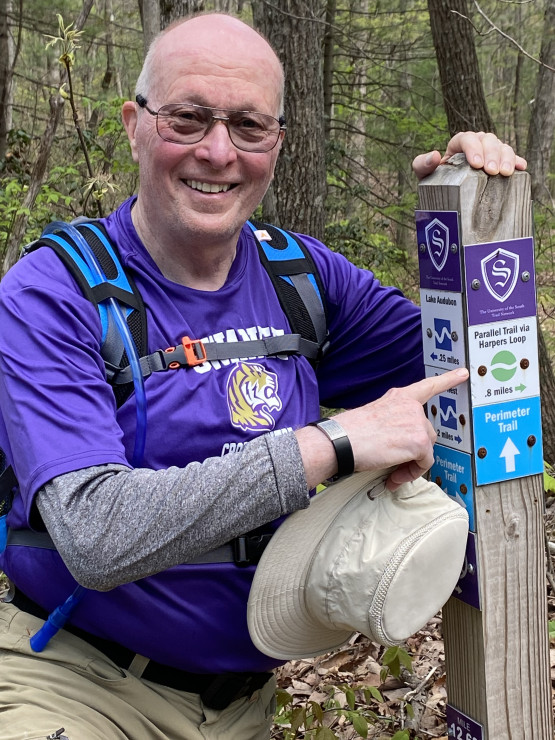
After graduation, Harper worked part-time in sporting goods stores while, eventually, serving as Vanderbilt University’s cross-country and track coach. While employed at an athletic apparel store in Nashville, he became running partners with a sales representative from Nike. When a new sales position opened within his friend’s division, Harper applied for the job and was quickly hired. Without any long-term planning, Harper says, he found a fulfilling vocation. “I took a job at Nike and worked there for 32 years. Then, I retired and lived happily ever after.”
Harper connected with Nike at an opportune moment—when he signed on, the company’s net revenue was $200 million, he says, and at his retirement, that figure had surpassed $50 billion. During his career, the company introduced Air Jordans and signed Tiger Woods. “I think [Woods’] contract was $50 million over four years,” Harper says. “Everybody thought, ‘You guys are nuts.’ But then our golf sales increased almost $200 million in one year.” Nike also brought Harper into contact with several acclaimed athletes, including Bo Jackson, Carl Lewis, and Olympic marathoner Frank Shorter.
While a degree in philosophy might not seem naturally related to a job in sales, Harper says Sewanee equipped him with valuable problem-solving and critical thinking skills, which positioned him to successfully assess and meet customers’ needs. When classmate Dale Grimes, C’75, asked him to serve on the Class of 1975 50th Reunion Fundraising Committee, Harper agreed to step up.
Along with his planned gift, Harper provides recurring gifts to the Sewanee Fund for scholarships and financial aid, and to Sewanee Athletics. To fund his planned contribution, he made Sewanee the beneficiary of an unneeded life insurance policy. “Kevin’s giving has been so thoughtful, and also tax-wise,” says Director of Gift and Estate Planning Allison Cardwell, noting that insurance policy gifts can provide significant tax benefits for donors.
Harper credits Dale Grimes and Greer Broemel, C’75, P’07, P’13, who co-chaired their class’s reunion fundraising committee, for pushing the Class of 1975 Endowed Scholarship Fund past $950,000 as of this month. The fund is for need-based aid and is designated for any student in the College of Arts and Sciences, regardless of geographic location or academic interests. Harper says this flexibility is important to him. “Our endowment will exist as long as Sewanee exists—and Sewanee’s needs will change over the years. There may be needs in 10 or 15 years that we can’t imagine today.”
Harper lives a little too far from the Mountain to return often, but he’s close enough for special occasions. And if he gets homesick for campus, there’s always the tattoo—though he points to a different part of Hall of Fame Weekend that was equally, if not more, memorable. “When Coach Meeks came back for the Hall of Fame ceremony, he just lit up, because he knew everybody,” Harper says. “That was a special weekend for me, just to see him so happy.”