“We had a top-notch faculty who could have been earning big bucks working at other institutions. But they chose to remain at Sewanee because they loved teaching there.”
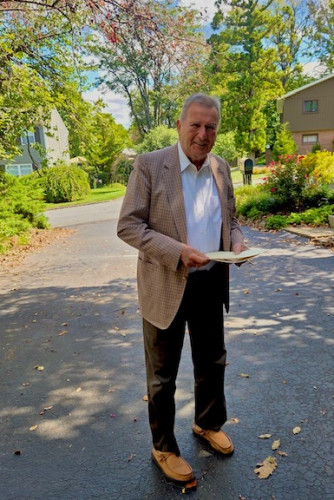
As the former president of the Sewanee Associated Alumni, Bob Rust, C’61, P’88, P’91, P’00, has attended more than a few reunions and heard stories from the Mountain spanning decades. One anecdote stands out—a memory shared by his late friend Ernie Cheek, C’61, at the Class of 1961’s 40th reunion in 2001.
Cheek was born in Sewanee and lost his father at a young age, Rust says. Subsequent financial challenges made it difficult for Cheek to foot the University’s tuition bill. At one point during his undergraduate career, he came up $50 short and told John Webb, P’66, who was then dean of students, about plans to drop out. Cheek’s description of what happened next continues to resonate with Rust. “Dean Webb reached into his back pocket and pulled out 50 dollars. He said to Ernie, ‘I know you’re good for it.’”
That story, Rust says, “brought tears to my eyes, and to a lot of other people.”
Looking ahead to his 65th reunion milestone this November, Rust says he’s excited to honor Sewanee faculty who, like Webb, go above and beyond for their students. In 2001, the Class of 1961 launched an effort to endow a faculty chair, under the leadership of former Board of Regents Chair Edwin Williamson, C’61; Tom Kandul, C’61, P’03, GP’20, GP’24; and the late Frank Pendleton, C’61, P’83. To date, the class has pushed the endowment to a market value of $1.58 million. In anticipation of this fall’s reunion, Rust is rallying with classmates to elevate the fund to $3.5 million—the financial threshold for a fully endowed chair at Sewanee.
Crossing the finish line on this ambitious fundraising initiative would give Rust a second reason to celebrate. He was also recently selected as the 2026 recipient of the Distinguished Service Award, an honor presented to alumni who display exceptional commitment to the University and its alumni network.
“Bob has stepped up for Sewanee in countless ways through the years, not only as a dedicated alumnus, but also as a Sewanee parent and former trustee,” says Jeff Zivan, C’93, P’22, director of alumni engagement. “It’s a privilege to shine a light on him, in the same way he has given outstanding focus to the University’s mission and legacy.”
Though Sewanee now factors prominently in Rust’s relationships and memories, it wasn’t always so. Growing up in Virginia, he knew little about the campus, he says—only that his grandfather had attended the University for a year after graduating from Sewanee Military Academy. “My grandmother said he couldn’t stop talking about what a wonderful place Sewanee was and how he wanted to take her there,” Rust says. “Unfortunately, he died before he could do that.”
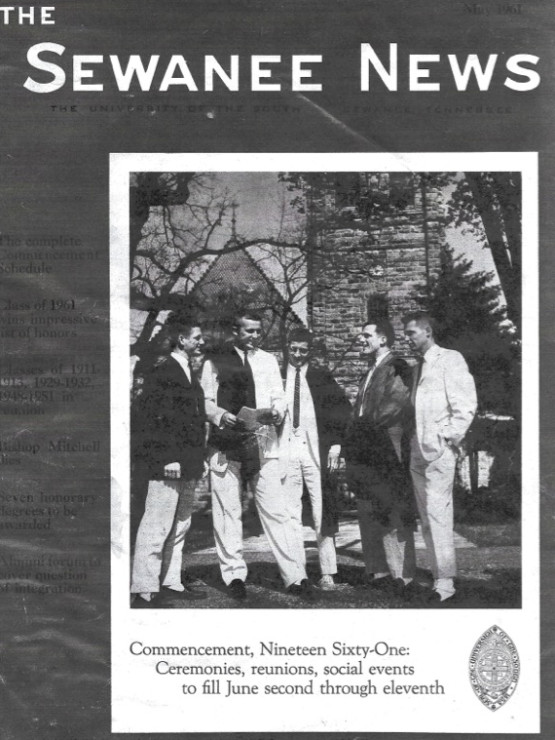
When the time came for Rust to apply to college, he put Sewanee on his list at his grandmother’s request. To his surprise, he was accepted—and, soon after, decided to enroll. In the fall of 1957, he took an overnight train from Alexandria to Chattanooga, then caught a bus to Sewanee. “I came [to the Mountain] sight unseen,” he says. “I almost wanted to turn around and go home.” Once he set foot on the Domain, though, all doubts faded. “I was hooked.”
Aspiring to a career in law, Rust majored in political science and explored a range of humanities courses. He says he especially enjoyed classes with renowned Professor of English Abbott Cotten Martin, who employed “a unique use of hyperbole and feigned insult in his teaching technique.” As an example of Martin’s distinctive style, Rust describes an observation Martin often made while presenting lessons on Greek literature and poetry. “He’d turn to us and say, ‘Gentlemen, when your ancestors were walking the Baltic painted blue, this poetry was being written.’” That type of vivid imagery, Rust says, “really sticks with you.”
As a freshman, Rust pledged Phi Delta Theta, and he served as the organization’s co-president for part of his senior year. He was also secretary of the Order of the Gown, a proctor at Tuckaway Hall, and an active member of the Red Ribbon Society. For two years, he played basketball under head coach Lon Varnell, P’59, P’61, P’65, who racked up a record-setting number of wins and was eventually inducted into the Tennessee Sports Hall of Fame.
Of Rust’s experiences on the Mountain, one ranks as particularly historic—he was in attendance when Louis Armstrong & His All Stars performed on campus, at the invitation of the Sewanee Jazz Society. Rust says the decision to host Armstrong was controversial at the time, with civil rights debates raging across the country. Jazz Society members E. Gray Smith, C’61, and Dave Wilson, C’61, took the lead in pushing back against societal pressures by offering Armstrong and other Black entertainers a friendly welcome, Rust says. Other greats hosted by the group during Rust’s time at Sewanee include the Modern Jazz Quartet and the Dave Brubeck Quartet.
Rust aimed to join the military after graduation, following the path of his father, who was a Navy Seabee during World War II. The University’s Office of Admission had different plans for the new graduate, though—Rust was tapped for an assistant director position. “I accepted, and I traveled all over the place,” he says. “I loved it.” One Sewanee superlative Rust enjoyed sharing was the University’s outstanding record for producing recipients of prestigious postgraduate fellowships. This bragging right “remains true today,” he notes.
After leaving Sewanee, Rust joined People to People International, a nonprofit founded by President Dwight D. Eisenhower in 1956. While working there, he met his wife, Lee-Anne. They’ve now been married for 62 years, and all three of their children are Sewanee graduates.
In 1966, Rust graduated from Vanderbilt University School of Law, where he was president of his class. For the past 22 years, he has led Rust Law LLC, an Allentown, Pennsylvania, firm specializing in business, real estate, estate planning, and administration. He says Sewanee’s honor code created a foundation for beliefs and values that have shaped his career. “I’m sure, as a student, I was not cognizant of the lessons being learned almost subconsciously.”
Rust acknowledges it may take some sweat to elevate the Class of 1961 Chair to a fully endowed level, but he believes his classmates are up to the challenge. For more than 30 years, he has facilitated regular electronic communications between his class, through a Sewanee multilogue. Often, the multilogue is a forum for sharing fond memories of legendary professors. “We had a top-notch faculty who could have been earning big bucks working at other institutions,” Rust says. “But they chose to remain at Sewanee because they loved teaching there.”
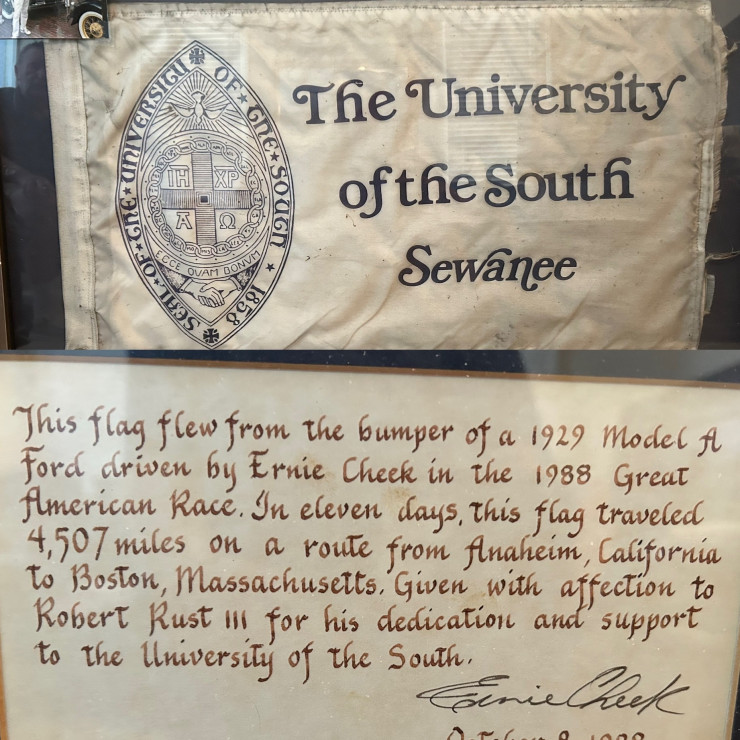
When Rust returns to the Mountain in November, he will bring a special piece of memorabilia—a Sewanee flag that Ernie Cheek designed for the Great American Race of 1988. As a participant in the competition, Cheek flew the flag on the back of his Model A Ford from California to Boston. After completing the 4,507-mile journey, Cheek gave the flag to Rust. The tight friendships formed among students during Sewanee’s all-male era are hard to describe, Rust says. “There’s no way I could replicate that experience for my children—only talk to them about the values that came out of that timeframe.”
One enduring value is the Domain itself. Rust believes his classmates have “a deep devotion to Sewanee,” because, he says, “the place gave them so much.”