“I hope that more people can immerse themselves in nature, learn how to protect it, and realize that this is our world and we’re all part of something larger.”
Diving into Marine Conservation
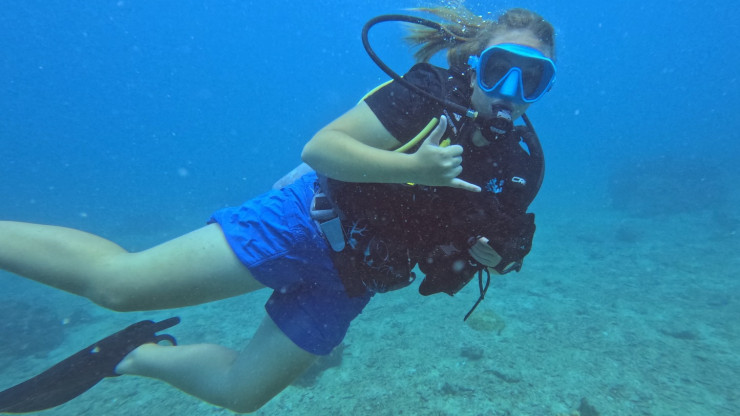
At the start of a summer internship, many students expect a slower first few days as they learn the ropes of their new environment. For Ava Bowron, C’27, that was decidedly not the case. Barely 24 hours after arriving at her internship site, Bowron dove right into the work in a very literal sense: Her first task was to complete both open water and advanced diving certifications in order to qualify her for the rest of her summer responsibilities.
An ecology and biodiversity major, Bowron had been looking for a summer opportunity that would get her into the water and give her the hands-on experience with marine ecosystems that wasn’t possible on Sewanee’s campus. With the support of the Sewanee Freeman Asia Fellowship, which provides selected students with up to $10,000 in funding for an internship experience in East or Southeast Asia, Bowron found just that in a position as a citizen scientist with a marine conservation organization called The Coral Tribe in Koh Tao, Thailand.
After completing her diving certifications, Bowron was set to spend nearly every day of the summer in the water, with each work day typically involving at least two distinct dives. Using her newly acquired skills, Bowron’s typical tasks included surveys of invasive species—like the crown-of-thorns starfish—to determine their threat to the local ecosystem or conducting a coral watch to assess color changes in the coral reefs that could indicate harmful coral bleaching.
One of Bowron’s favorite activities was the periodic Dive Against Debris, during which she and her fellow divers would remove abandoned fishing nets—sometimes having to cut them off of the coral reefs around which they had become entangled—and other trash as a means of cleaning up the environment and fighting the negative impacts of tourism in the region. “With the Dives Against Debris, it was good to know that we were doing valuable work and actively protecting creatures from harm,” says Bowron. “Physically removing these materials made the impact of our work feel tangible.”
Because The Coral Tribe’s work involves data collection and dissemination in addition to its conservation efforts, Bowron’s time in Thailand also made her academic pursuits feel more concrete. Results from the surveys that Bowron and her colleagues recorded will be shared with scientists around the world, eventually underpinning the articles and studies that are the basis of her current coursework. And thanks to her time in the water—where challenges included managing her air consumption at depth while swimming through currents or navigating around a shipwreck with limited underwater visibility—she’s seen firsthand just where that data comes from.
“This internship confirmed exactly what I want to do, which is to be a marine ecologist doing my own research and continuing to be out in the water as much as possible,” says Bowron. And, after witnessing the direct threat that humans can pose to some of the world’s most spectacular creatures, the internship also confirmed Bowron’s commitment to conservation and sustainability.
“During this internship, I got to love the ocean even more,” says Bowron. “I hope that more people can immerse themselves in nature, learn how to protect it, and realize that this is our world and we’re all part of something larger.”