2026 Senior Oration
At Commencement on Sunday, May 10, Algernon Sydney Sullivan Medallion recipient Daphne Chigozim Nwobike delivered the Senior Oration. Watch her remarks below.

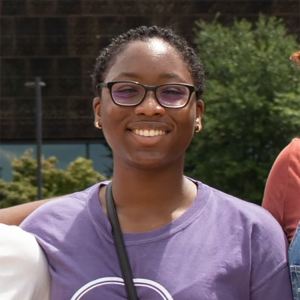
Daphne Nwobike, C’26
Daphne Nwobike is a politics and Spanish major from Hyattsville, Maryland
Good morning,
To the Chancellor, Vice-Chancellor, our honorary degree recipients, and esteemed guests—
To our incredible faculty and staff—
To our families, both near and far, whose support has kept us going—
And, most importantly, to the Class of 2026.
My name is Daphne Nwobike, and I stand before you today as a recipient of the Algernon Sydney Sullivan Award. This distinction captures Sewanee’s commitment to honoring integrity, service, and strength of character.
I have the great pleasure and privilege of congratulating the class of 2026 on this incredible achievement. We made it!
I can still remember freshman year like it was yesterday, yet here we are, standing on the cusp of a new chapter. Our long nights and hard work have truly paid off.
I am immensely proud of every one of you. We have traveled through four long years, full of twists and turns, highs and lows. But through it all, we persisted and have made it to the finish line. Let us go on a trip down memory lane to reflect on just how far we’ve come.
Our class is a special one. We got to Sewanee at the tail-end of COVID-19, when the world was trying to find its bearings after a global pandemic that fundamentally changed everything we considered “normal.” We could finally put down our masks, but the walls erected by years of social distancing were much harder to overcome.
We had to re-learn how to live in community and co-exist with those different from us. Class of 2026, we did our best to figure out this new normal—we sought relationships with each other, our professors, and staff members, all so we could enrich our sense of community here.
Ironically, despite our best efforts to embrace this new normal, the world around us grew increasingly divided.
During our time at Sewanee, we’ve seen the advent of multiple events that have created distinct polarization in the world today. We’ve witnessed international conflicts from Gaza to Congo. We’ve witnessed the strain and tension created by the 2024 election. We’ve witnessed conversations about ICE and immigration intensify like never before.
These tensions didn’t escape Sewanee, where we also navigated conversations that threatened to fray our newfound connections. We whispered about the Gaza protests that seemed to create an insurmountable divide on campus. We whispered about changes made to our Office of Diversity, Equity, and Inclusion and the implications it spelled for Sewanee moving forward. We whispered about symbols and words that actively excluded members of this community. We whispered about the exodus of core staff and faculty members who supported and advocated for students’ well-being. We whispered, but these tensions persisted.
Through all of this turbulence and uncertainty, our class grappled with the desire to stay grounded and informed while also seeking escape in our 2 a.m. visits to Waffle House and 20-mile hikes along the perimeter trail. Some of us turned to our academics, others found community in Greek life, while still others did their best to be as involved as possible on campus. While trying to have as normal a college career as possible, we silently panicked and worried about the world we’d be inheriting after graduation.
We’ve all taken different approaches to surviving and making sense of this post-pandemic, polarized world. For me, service and community building helped me come to terms with all that I could not control. Before college, I served to fulfill my high school graduation requirements. At Sewanee, however, I began to see service as one of the most effective and meaningful ways to remember our shared humanity.
I’ll always remember my first day stocking shelves and welcoming neighbors at the Community Action Committee Food Pantry. Here I was having conversations and sharing stories with people vastly different from me, yet all that mattered was everything we had in common. As a first-generation immigrant who has had to search for belonging in an unfamiliar society, I’ve come to realize that there exists an endless fount of belonging and acceptance in the smiles of those we support with our time, kindness, and service.
There is so much love in the embrace of a pantry visitor mourning her late husband—
In the drawings of an unhoused person eager to share their talents—
In the laughter of a young child excited to play with the student volunteering at Blue Monarch.
Every second spent serving at Sewanee or going on an outreach trip to another community allowed me to connect with individuals whose experiences expanded my worldview, reinforced the importance of empathy, and reminded me that being human is more important than being right.
So, class of 2026, why should you care about service? What does it matter if you spend a couple of hours lending a helping hand to those in your community?
Before I answer, I want you to take a moment to reflect. Think about the times you’ve desired to feel seen and respected. Think about the times that you’ve sought the care of another but couldn’t find it. Think about the times you’ve withheld your compassion and empathy from another because it simply required too much of you.
Those feelings, of being unseen, of being alone in difficult moments, of wishing you had shown up differently for someone, are not weaknesses. Rather, they are the emotions that we can all relate to, regardless of our backgrounds. Service is the practice of taking those feelings seriously and channeling them into actions that empower both you and others.
If Sewanee and service have taught me anything, it is the importance of being brave enough to leave the bubble of what you know to explore the vast world and the many experiences it offers.
Whether you’re visiting St. Mark’s, Sewanee’s historical black community, for the first time—
Learning about an unfamiliar discipline of study—
Playing sports with a new team—
Or simply living in a dorm community unlike any you’ve encountered (I’m talking about you, Benny)—
Daring to learn more about others, even when it feels like the last thing you want to do, is more rewarding than you can imagine.
Sewanee isn’t a perfect place, and there is so much work left to do here. But as I stand here with so much gratitude, I cannot deny that Sewanee has given us unique insights and experiences thanks to the dedication of all the professors, staff, and community members who have been deeply invested in our learning.
So before we leave this mountain, I want to name three things this place taught us. Three things I hope we carry with us.
First, curiosity is fundamental. Whether you were spending your days outside analyzing rocks in a geology class or examining the meaning of death, dying, and grief in a philosophy course, you were undeniably satisfying some craving to know more about the world and the way it works. Curiosity takes us on adventures abroad, where we encounter the complexities of different cultures and societies. Curiosity encourages us to ask difficult questions that bring us one step closer to full understanding. Curiosity compels us to seek out knowledge, truth, perspectives, and experiences that lead to an informed life. We have come this far by being curious, and as we venture into the real world, we must cherish and nurture this need to know more about ourselves and the world around us.
The second lesson we must take with us is that service is the purest way to see others. Last summer, I interned at Miriam’s Kitchen, a D.C.-based organization dedicated to eradicating homelessness in the city. I spent each day interacting with unhoused people. While serving food and distributing clothing, I listened to their stories and tried to empathize with their fears. In doing this work, I discovered that prior to this experience, I had grown accustomed to not seeing their suffering—to ignoring them when it felt uncomfortable to acknowledge their struggles. Service has a way of forcing us to see the hidden injustices around us. It has a way of urging us to see the people behind the numbers and statistics that often strip them of humanity. By serving others, we tell them, “I see you,” and we position ourselves to offer companionship. We don’t serve to save anyone. We serve to be present with another person’s reality long enough that it becomes real to us, too.
The third lesson is the simplest, and maybe the hardest: Love your neighbor. Merriam-Webster defines love as an “unselfish, loyal, and benevolent concern for the good of another.” Matthew 22:39 calls loving your neighbor as yourself the “second greatest commandment.” Although it may sound cliché, loving your neighbor is the most radical thing you can do in a world that has forgotten how. Your neighbor, simply put, is your fellow human. Your neighbor could be a stranger or your closest friend. Your neighbor could share your beliefs about life, or they could disagree with everything you hold dear. Sewanee has taught me the importance of loving my neighbor fiercely—despite the differences that seem to separate us.
I will never forget how we all rallied around our neighbor, who sought financial support to secure his family’s safety during a period of conflict. In a few days, we raised thousands of dollars—all because we knew this student was our neighbor and needed our support. Love led us to action. Whether it’s through monetary donations, checking in on a friend going through a hard time, or offering a simple hello, loving your neighbor takes a little effort but makes a great difference.
There will be moments when loving your neighbor asks you to be uncomfortable, to be vulnerable, to challenge your assumptions, and to step out of your comfort zone. Do it anyway.
There will be moments when your neighbors don’t reciprocate your love—when they feel undeserving of your affection. Love them anyway.
I chose these three lessons because wherever we go next, there will be neighbors who need love, people who need to be seen, and problems that require our curiosity. The world beyond the Domain waits for us to make a difference. So as we embark on this new journey, let us hold onto the lessons, memories, people, and experiences that have propelled us this far.
Class of 2026, remain curious, stay committed to service, and above all, love your neighbor. The future is bright, and I can’t wait to see what it holds for us.
Congratulations to the class of 2026!