Ancient Bamboo on the Domain May Be Tennessee’s Oldest Living Organism
New study finds millennia-old native bamboo growing on the 13,000-acre Domain and in nearby Franklin State Forest
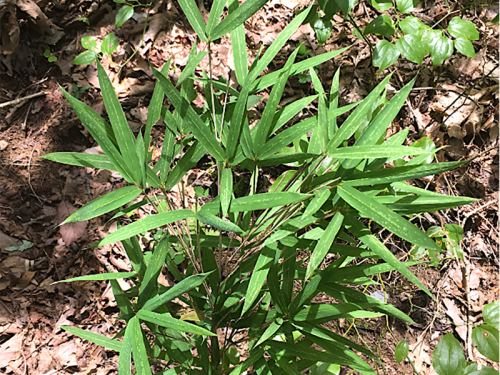 Hidden beneath the forest floor on the 13,000-acre campus of the University of the South and in Franklin State Forest just eight miles away, a native bamboo species has been quietly growing for centuries—perhaps millennia—without ever flowering. A new study published in the American Journal of Botany reveals that populations of hill cane (Arundinaria appalachiana) at these two sites are dominated by enormous, ancient clones that may represent the oldest known living organisms in Tennessee.
Researchers from the University of the South and Furman University used genetic analysis and long-term field monitoring to uncover the hidden structure of hill cane populations on the southern Cumberland Plateau. By combining DNA sampling with nearly a decade of detailed mapping of underground rhizome networks, the team found that single genetic individuals extend across tens of hectares and have persisted for more than 1,700 years—far older than any previously documented living organism in the state.
“What’s remarkable is that one of these ancient clones is growing right here on the Sewanee Domain,” says lead author Jon Evans, professor of biology at the University of the South. “Another clone of comparable size occurs in Franklin State Forest, just down the road. These are not remote wilderness sites—they’re familiar landscapes that people pass through every day.”
Hill cane survives almost entirely through slow, steady clonal growth. While individual bamboo shoots live only a few years, underground rhizomes persist and spread gradually through the soil, producing new shoots over centuries. Some of the clones documented in this study likely began growing around the time of the Roman Empire and have endured continuously ever since.
Unlike most plants, bamboo species flower only once after decades or centuries of growth, producing seeds before dying. However, Arundinaria appalachiana has never been observed to flower anywhere in its range. The new research suggests that today’s populations on the Sewanee Domain and in Franklin State Forest may be remnants of a single ancient flowering event, surviving ever since without sexual reproduction.
The study also revealed signs of concern. While hill cane populations in Franklin State Forest remained stable, portions of the clone on the Sewanee campus showed significant declines in shoot density over time, even in the absence of major disturbance. Without flowering and seed production, the species has no way to generate new genetic diversity, potentially limiting its ability to adapt to drought, disease, and climate change. “This species embodies a paradox,” Evans said. “Its extreme longevity has allowed it to persist for thousands of years, but that same strategy may now place it at risk.”
Hill cane is endemic to the southern Appalachian Mountains and was only recognized as a distinct species in 2006. Like other native Arundinaria species, it was once a key component of vast canebrakes that covered much of the southeastern United States—an ecosystem that has declined by more than 98 percent since European settlement.
The authors emphasize that conserving hill cane requires protecting entire landscapes, not just visible plants. On the Sewanee Domain and in Franklin State Forest, this means safeguarding forest conditions, soils, and hydrology that sustain the extensive underground networks of these ancient clones. “To realize that one of the oldest living organisms in Tennessee is growing beneath our feet—on a college campus and in a nearby state forest—is both humbling and motivating,” Evans says. “It reminds us how much deep natural history is embedded in the places we think we already know.”
The full study, “Spatial genetic structure of Arundinaria appalachiana (hill cane), an upland bamboo species endemic to the southern Appalachian Mountains,” appears in the American Journal of Botany.