Easter Semester Convocation Features Installation of the Dean of the College and Talk by Mila Dragojević
Jan. 20, 2026
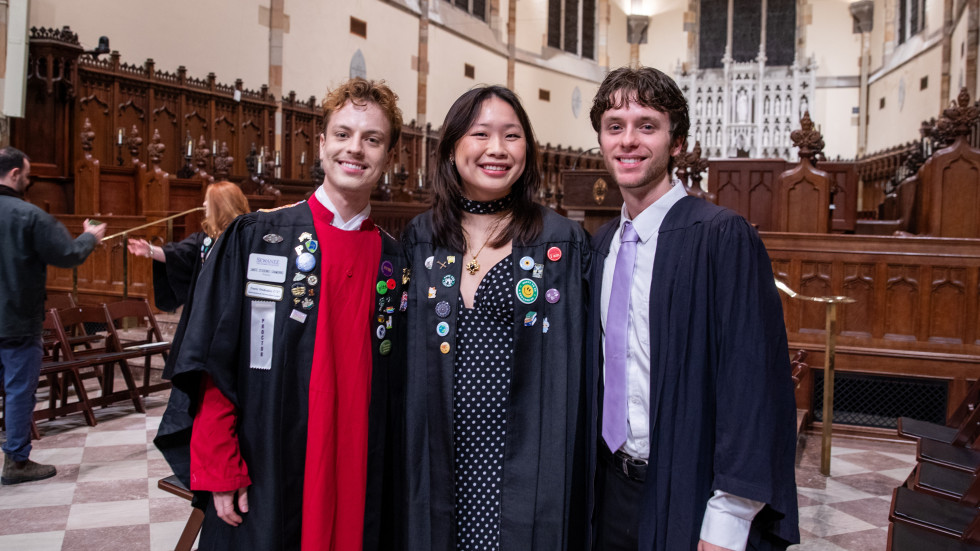
The University of the South held its Easter Semester Convocation on Friday, Jan. 16, to induct new members into the Order of the Gown, celebrate the installation of Jennifer Cooley as the dean of the College, announce the recipients of awards and prizes, and, following a tradition established in 2024, recognize the teaching and scholarship of the faculty by featuring remarks delivered by a University professor. This year, Professor and Chair of Politics Mila Dragojević, an internationally respected scholar of nationalism, ethnic politics, and political violence, was selected to give the convocation address. Read the Easter Semester Convocation bulletin here.
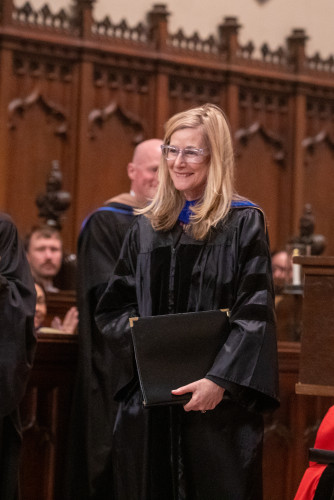 Following the opening prayer and readings, University Regent Gene Manning, T’01, presented Cooley to Vice-Chancellor Rob Pearigen and Presiding Chancellor Neil Alexander for her installation as dean of the College. Provost Scott Wilson then announced the recipients of several awards and prizes.
Offering a welcome and introduction of Dragojević, Pearigen reflected on the tradition, now in its third year, of inviting a member of the University faculty to speak at the Easter Semester Convocation. Each year, Pearigen noted, the ceremony has been enriched by the voice of a scholar whose work reaches beyond the Domain, and whose teaching shapes lives within it. “This tradition reflects something essential about Sewanee—that moments of reflection and purpose are often best guided by those who teach, mentor, and learn alongside our students every day,” said Pearigen.
A professor in the College since 2010, Dragojević’s scholarly work has appeared in numerous peer-reviewed journals, and she has published two books: The Politics of Social Ties: Immigrants in an Ethnic Homeland (Ashgate/Routledge, 2014/2016), in which she examined political incorporation of former refugees from Bosnia and Herzegovina and Croatia in Serbia; and Amoral Communities: Collective Crimes in Time of War (Cornell University Press, 2019), in which she studied the local conditions associated with violence against civilians in Croatia, Uganda, and Guatemala. Her third book, An Uncertain Spring: Reform, Protest, and Suppression in Croatia, 1968-1971, is forthcoming from Indiana University Press. Her research has been recognized with awards and funding from the Harry Frank Guggenheim Foundation, the Fulbright Program, and the Appalachian College Association, and she has also received numerous faculty research grants from the University, including the McCrickard Faculty Development Grant and the Kennedy Fellowship.
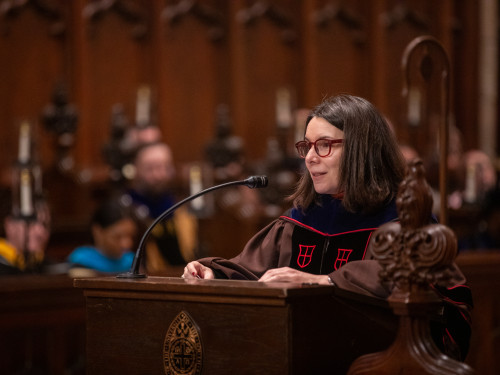 During her remarks, Dragojević spoke about how her early life experiences led to her current career and line of scholarship. After she and her family became refugees following the outbreak of war in Yugoslavia in 1991, Dragojević shared, she was confronted with the experience of witnessing a community unravel right in front of her eyes. “How do people who once lived side-by-side peacefully suddenly become deadly enemies? How do cultural characteristics, such as religion, race, ethnicity, or language become the sources of political divisions? How does a political conflict escalate into mass violence? These are the questions I pose today as a scholar and a member of this community for the past 15 years,” she said.
Dragojević concluded her address with a consideration of what ordinary citizens can do to prevent political violence, sharing the need to establish communities of trust, study past conflicts, and lead with our personal strengths. “We can be leaders for peaceful coexistence in our own ways by nurturing our most valuable individual qualities, such as compassion for each other, honing our particular skills and expertise, and practicing personal integrity so that we can serve as the role models for future generations,” said Dragojević.
Order of the Gown President Lily Mobley, C’26, then addressed the new members of the order. Speaking about the gown’s long history at the University, Mobley noted the inspiration she found in its longevity, progress, and adaptations over the years. Reflecting on the responsibilities that new members of the order assume by wearing the gown, Mobley urged the inductees to promote justice in their community. “We are grounded by the persistence of [the gown’s] tradition, but we are also inspired by its ability to learn and to grow and to change,” said Mobley. “By taking the steps to inquire, you're actively choosing to participate, to learn, to study, to question, and to make change.”
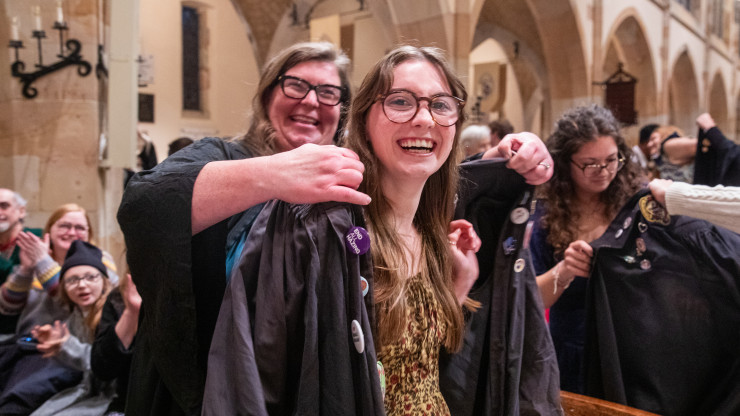
Vice-Chancellor Pearigen then formally admitted the new members of the Order of the Gown, concluding the ceremony. A full list of inductees can be found here.
The convocation was livestreamed for those unable to attend; the video is available below.